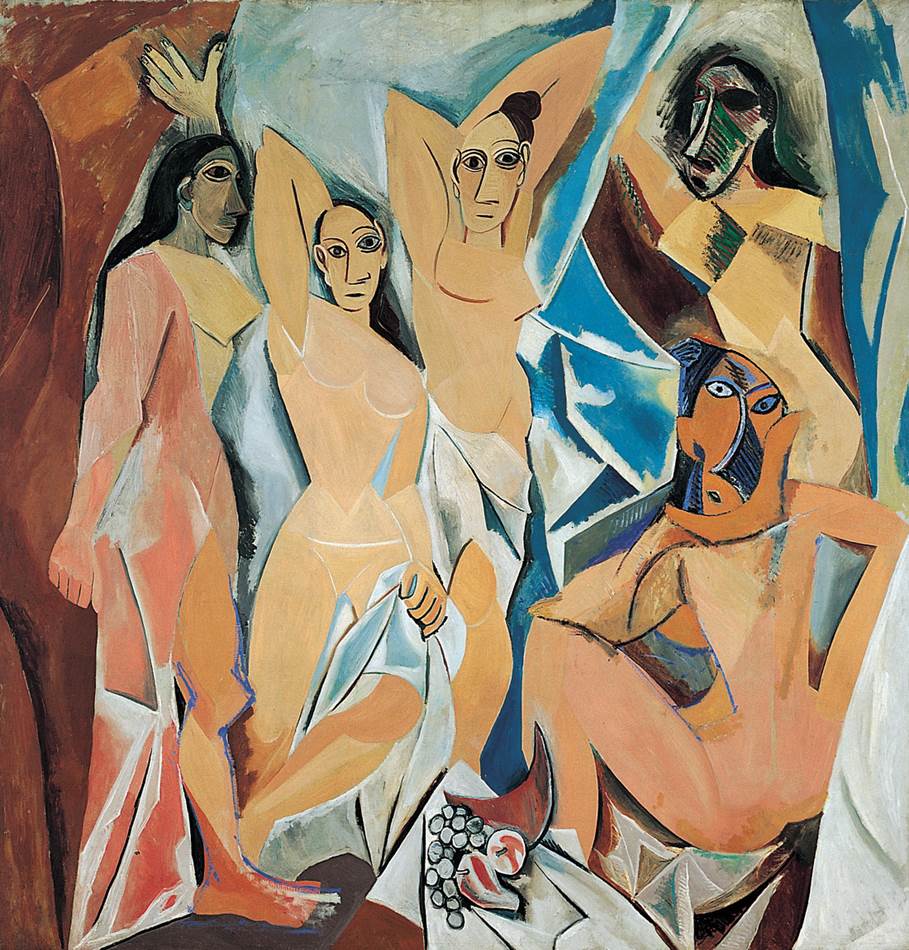
Pablo Picasso, “Les Demoiselles d’Avignon,” 1907.
In Les Demoiselles d’Avignon, Picasso engaged with the “primitive” through his use of formal qualities and subject matter, in a process where the “primitive” “is displaced contextually and historically through its appropriation by the west.”[1] At this time, objects from Africa, parts of Asia and the Americas were still regarded as objects of curiosity, having only ethnographic value, and were not, according to western standards, objects of fine art.[2] It would be years later, after the painting was made, that Picasso would admit to the impact African art had on him. In 1937, he spoke with André Malraux about his first trip to the Musée d’Ethnographie and its significance to his work, Les Demoiselles d’Avignon in particular:
‘When I went to the old [Musée d’Ethnographie], it was disgusting…I was all alone. I wanted to get away. But I didn’t leave. I stayed. I understood that it was very important…The masks weren’t just like any other pieces of sculpture. Not at all. They were magic things…They were against everything – against unknown, threatening spirits. I always looked at fetishes. I understood; I too am against everything…Spirits, the unconscious (people still weren’t talking about that very much), emotion – they’re all the same thing. I understood why I was a painter. All alone in that awful museum, with masks, dolls made by redskins, dusty manikins. Les Demoiselles d’Avignon must have come to me that very day, but not at all because of the forms; because it was my first exorcism-painting – yes absolutely!’[3]
Although, it is uncommon today, to put people on display as objects of curiosity, this Orientalist ideology still warrants challenge.[1] Why? Because, in this age of globalization, power binaries between “us” as superior, to those that are “other” than “us” are still operating, particularly in areas of race, religion and gender. Post-colonial discourse draws attention to the ineffectiveness of this binary system today, recognizing that cross-cultural exchange has created caveats in the system of “us” as defined in contrast to “other.” These caveats, breathing-rooms, or spaces “in-between,” according to Homi K. Bhabha, are contentious spaces that subvert universalizing meta-narratives, “genealogies of ‘origin’ that lead to claims for cultural supremacy and historical priority.”[2] It is in these “in-between” spaces, where consciousness-raising may take place that may start to heal traumas of past injustices, in order to bring-about greater cultural equity. Art functions as a vehicle for this, fostering dialogue and critique, challenging universal cultural norms, subverting longstanding ideologies, creating “breathing-rooms” where recognition, identification and consciousness-raising may take place – and, although challenging to many involved, this task was accomplished by performance artists Coco Fusco and Guillermo Gómez-Peña, in the 1993 documentary The Couple in a Cage.[3]
In 1992, Fusco and Gómez-Peña took it upon themselves to confront this colonial binary, its historicity and relevance today, by creating performance art, where they staged and performed as newly discovered, never-before-seen, native Amerindians, first at the Edge ‘92 Biennial, and later at art and natural history museums.[4] They called themselves Guatinauis, authored a native language, and constructed a cage, in which they would be displayed, with objects from their native land (which included things that had washed-up on the shore of their imagined island, like a radio and television). Additionally, they created a display, with a map and museum entry, explaining that the Guatinauis came from an island located off the east coast of Mexico, and that “these specimens [were] descendants of Wiliwili stock.”[5] Fusco and Gómez-Peña titled the performance Two Undiscovered Amerindians Visit, and conceived the entire performance “as a satirical comment on the past;” but, to their surprise “many of their visitors thought they were real [specimens on display].”[6] Paula Heredia made the film in collaboration with Coco Fusco, editing footage of the performances, as the Guatinaui couple toured the United States, Spain, Australia (and later Argentina, although this was not included in the documentary), with archival footage and photographs of people of color having been put on display throughout history, interviews of visitors to Two Undiscovered Amerindians Visit, commentary by a mock anthropologist and textual narration, all accompanied by music. It is through the medium of film, in this form, a documentary, that their new audience may view their art performance as contextualized within historical precedents, and that their performance may be viewed as a reverse ethnography, since the film centers on interviews of initial viewer’s responses to their caged performance.[7]
Unlike the experience of the initial viewers of Two Undiscovered Amerindians Visit, viewers of the documentary are made aware that what they are viewing is in fact a performance. Initial viewers provided a range of responses to the art performance, seeing the exhibited Guatinauis, many were unaware that what they were experiencing was performance art.
In the 2006 anthology, F is for Phony: Fake Documentary and Truth’s Undoing, editors Alexandra Juhasz and Jesse Lerner address the role of the fake documentary, what it is, how it is often self-reflexive, and how it innovatively allows for critique of the documentary film-making process, while providing an unique presentation of culture. In the “Introduction” Jesse Lerner writes, although “Fusco and Heredia’s documentation of the performance/hoax is not a work of fiction, [yet] it is certainly at the very least a close cousin, if not a member, of our ‘fake documentary’ family.”[1] And, that although The Couple in the Cage centers on the spectacle of the “primitive,” it is a “very real sounding board[s] for the study of deeply felt Western racial hierarchies, fantasies of the tropics, and imperial ambitions,” and functions as a mechanism for cultural critique.[2]
I would argue, what the documentary The Couple in the Cage has to offer, which is so powerful, is that in viewing this exchange one is taken to the space “in-between” the performance and the initial viewer interaction, thereby brought into a space that clearly illustrates how Orientalist practices are still at work today. Likewise, their performance and the documentary The Couple in the Cage is clearly situated in the contemporary context of visual culture and postmodernity; here, the artists as performers, challenge the viewers to consider themselves and internal mechanisms at work in cultural processes, like stereotyping – realizing the impact of western ideology. Furthermore, Fusco explains that through the performance “even though the idea that America is a colonial system is met with resistance—since it contradicts the dominant ideology’s presentation of our system as a democracy—the audience reactions indicated that colonist roles have been internalized quite effectively.”[1] Coco Fusco performed “the role of a noble savage behind the bars of a golden cage” with Guillermo Gómez-Peña to call attention to the inaccuracy of/with the notion of “discovery,” that began with Christopher Columbus, and that resulted in formulating a narrative which labeled indigenous peoples by the west as “other.”[2] With the advent of film, the colonial gaze has transitioned from exhibitions of “primitive” peoples and their representations, to “another commercialized form of voyeurism—the cinema…Founding fathers of the ethnographic film-making practice, such as Robert Flaherty and John Grierson, continued to compel people to stage their supposedly ‘traditional’ ritual, but the tasks were now to be performed for the camera.”[3]
On Picasso:
[1] Hal Foster, “The ‘Primitive’ Unconscious of Modern Art” in Art in Modern Culture: An Anthology of Critical Texts. New York: Phaidon Press Ltd. and the Open University, 1992: 199-209. Also, see Gill Perry on the “Primitivism and Modernism,” in Primitivism, Cubism, Abstraction: The Early Twentieth Century. Charles Harrison, Francis Frascina, Gill Perry, Eds. New Haven: Yale University Press, 1993.
[2] James Clifford . “On Collecting Culture,” in The Visual Culture Reader edited by Nicholas Mirzoeff. London: Routledge, 1998: 94-107. This article deals initially deals with the ways in which “ethnic” or tribal artifacts are collected and displayed as ethnographic artifacts to the western recognition of these objects as works of art. Clifford questions appropriation and authenticity in considering how these objects contribute to cultural identity.
[3] Patricia Leighton. “The White Peril and L’art nègre: Picasso, Primitivism, and Anticolonialism.” Art Bulletion. Dec. 1990: 625.
On ‘The Couple’:
[1] In “The Other History of Intercultural Performance,” Coco Fusco mentions Tiny Tina, a black woman midget, who, in 1992, exhibited herself at the Minnesota State Fair. Coco Fusco. “The Other History of Intercultural Performance,” in English is Broken Here: Notes on Cultural Fusion in the Americas. New York City: The New Press, 1995: 43.
[2] Homi K. Bhabha. The Location of Culture. London: Routledge, 1994: 225-26.
[3] Coco Fusco and Paula Heredia. The Couple in the Cage: A Guatianaui Odyssey. Art Institute of Chicago Video Data Bank, 1993. See the following link to view the entire documentary: http://vimeo.com/79363320.
[4] Amerindian is defined as: “any member of the peoples living in North or South America before the Europeans arrived.” See the following link for this definition: http://www.thefreedictionary.com/Amerindians.
[5] Coco Fusco and Paula Heredia. The Couple in the Cage: A Guatianaui Odyssey. Art Institute of Chicago Video Data Bank, 1993.
[6] Ibid.
[7] Coco Fusco refers to the performance as a “reverse ethnography” as well. See: Coco Fusco. “The Other History of Intercultural Performance,” in English is Broken Here: Notes on Cultural Fusion in the Americas. New York City: The New Press, 1995: 57. Also, in the current practice of documentary film-making, it would be ethnically appropriate to have those interviewed on film sign a release, letting them know that the footage of their interview may appear in the film. Given the nature of The Couple in a Cage, it is doubtless that this was done and I found no reference to this action in my research.
[1] Jesse Lerner. “Introduction” in F is for Phony: Fake Documentary and Truth’s Undoing, Alexandra Juhasz and Jesse Lerner editors. Minneapolis: University of Minnesota Press, 2006: 20. Additionally, Juhasz writes that fake documentaries are “productive and often progressive” in that they tell by “(un)doing” (page 11). Additionally, questions such as: “What do they contribute to conversations about the permanence and malleability of identity nation, and location, both in and out of representation? And why is a challenge to, and application of, a representational regime of truth so useful for filmmakers with a social, as well as a formal, agenda?” (page 11) are integral to understanding the role and tool of the fake documentary.
[2] Ibid: 25.
[1] Coco Fusco. “The Other History of Intercultural Performance,” in English is Broken Here: Notes on Cultural Fusion in the Americas. New York City: The New Press, 1995: 48.
[2] Ibid: 37-63.
[3] Ibid: 49.
 arthistoryvisualculturalstudies
I appreciate how you looked at the piece through the lens of the in-between space. At times I felt it was unfair to put observers of the cage performance in that role as audience without knowing the real intentions of the piece. But I have always thought that candid camera moments meant to mock people were unfair and unkind. The history of “orientalist practices”, though, is not just a colonial act. I think it goes both ways. When encountered with strangeness and “otherness” most human cultures have created simplified caricatures and narratives. Not that it should be condoned, but it seems to be way of processing the unknown.
LikeLiked by 1 person
I am interested in you thinking about this space “in-between” a performance and its document/ary. Very different viewing practices; very different possibilities; and yet quite closely linked. Jesse is right, as I read him again, the documentary of a fake is different from a fake (see Orson Welles’ F for Fake, of course). I think it’s important to begin with Picasso, but do wonder, as well, the connected differences of seeing masks on a wall and seeing couples in a cage.
LikeLiked by 1 person
Reading your article I thought of how many times I’ve visited the Smithonsian’s Folklore Festival. Individuals from around the world were not in cages, but were on display along with their folk arts. The points in your article made me reconsider how I behave as an observer of “others,” whether performing on stage or in the cinema.
LikeLiked by 1 person
I too was left thinking about the power of ethnic performance, and the difference in masks worn on the body vs displayed elsewhere. Does documentary ask participants to wear masks by default? If so, what does it mean to adopt alternative masks than the ones audiences want to see? When we draw attention to the masks, does that amplify their power or reduce it?
LikeLiked by 1 person
I think that you raise really good questions and in reading your comments I though about performativity. Could we consider modification of behavior, in certain contexts, like wearing masks?
LikeLike
This is interesting research. Perhaps the blog post could clarify the connection between the performance of the couple in the cage and Picasso.
LikeLiked by 1 person
Thanks and I appreciate your comment. In writing the paper for Dr. Juhasz’s Visual Research Methods class, I did go further linking the Picasso example to the contemporary performance. On the blog, I wanted to emphasize just the visual and let my readers consider the possible links, without my direction.
LikeLike
The Fusco and Gómez-Peña work provokes a lot of thought about history, assumptions, and ethics. As viewers of the documentary, it certainly reminds us how much we, as a society, continue to be imbricated within colonial discourses. I think I would have been interested in delveing even deeper into the exhibit itself–I’d be interested in reading more of your analysis of the various elements within the documentary itself. For instance, there was a woman who was really upset by seeing people in a cage. I thought that was an interesting moment as was when those who felt it was a performance. There’s also the violation that happens in the reverse gaze. They called it a satirical comment on the past but certainly it also was about recording the reaction of audiences. It’d be interesting to read more about the ethics of such a tactic. And yet, I still wonder why hardly anybody did question why people were in a cage. What about the narrative of the west condones it?
LikeLiked by 1 person
Great topic and a great post. The fact that this was done at museums opens onto a field with a lot of really interesting questions which challenge notions of looking and display. The concept for the performance art piece, I remember, was not only grounded in orientalist museum presentation– it was also grounded (as you mentioned in class) in 18th and 19th century world’s fairs and colonial exhibitions.
It’s not surprising therefore that many museums would like to try and distance themselves from many of these types of narratives. Indeed, the Chicago Museum of Natural history was founded the Chicago World’s Columbian Exhibition in 1894– which had an enormous midway thoroughfare that was chock full of human zoos. I for one am really curious what the thought process was behind “The Couple In The Cage” from the perspective of a museum director, and how it was brought to the various museums it was presented at, and moreover what actual audience interpretations were of it as a performance piece. We get a little of this from the film, but it’s somewhat limited.
Also, the Picasso connection is really great.
LikeLiked by 1 person